How companies earn money with charging stations and commercial storage facilities
Author: Julie Vandegaar
Reading time: 5 min
Table of contents
The demand for commercial charging points is increasing
Electromobility took a short breather in 2024: For the first time, fewer e-cars were newly registered in Germany than in the previous year. According to the Federal Motor Transport Authority (KBA), a total of 380,609 electric cars (BEV) were newly registered in 2024. This is almost 144,000 fewer than in 2023 (source 1). Political uncertainties and the expiry of the purchase premium for electric cars at the end of 2023 are among the reasons for the decline. (Source 2)
But there is no cause for concern – on the contrary: the signs are pointing to growth again in 2025. While the market declined last year, experts are expecting a turnaround in the new year: The share of electric vehicles in company fleets is set to rise from 16 to 26 percent, according to the forecast by market research company Dataforce. (Source 3)
On the one hand, this is due to stricter emission standards for car manufacturers in the EU. The limit value for CO2 emissions from new cars sold is currently 115.1 grams/kilometer. Since the beginning of the year, this value has fallen to 93.6 grams. (Source 4) On the other hand, charging points have been mandatory for commercial buildings with more than 20 parking spaces since 2025. They must provide at least one charging point for electric vehicles. (Source 5) Of course, electrified models also remain extremely attractive in the fleet market.
However, as the number of e-vehicles increases, so does the challenge: how can a reliable charging infrastructure be set up without placing an unnecessary burden on the grid connection capacity? Companies with electrified fleets (such as e-trucks) in particular face the challenge of providing sufficient charging points. Fast-charging stations and intelligent commercial storage solutions play a key role here.
How companies can benefit from the energy transition?
The energy transition offers companies a wide range of opportunities: from cost savings through renewable energy to new business areas. Find out how your company can benefit from this transformation – to the blog.
Charging solutions for companies: the types of charging stations
Charging stations are basically „gas stations“ for electric vehicles. They make it possible to charge the batteries of e-cars, e-trucks and other electric vehicles. But charging stations are much more than simple power sources. They are intelligent systems that not only enable the charging of electric vehicles, but can also control energy flows efficiently. Fast-charging stations in particular are becoming increasingly important, as they drastically reduce charging times and therefore represent a practical solution for the commercial sector.
- AC stands for „Alternating Current“, i.e. alternating current. It is mainly used for wallboxes, i.e. compact charging stations mounted on the wall, in private settings or at the workplace, as these are connected to the low-voltage grid. AC charging stations usually allow charging power of up to 22 kW.
- DC is the abbreviation for „Direct Current“ and means direct current. It is mostly used at public charging stations, some of which are connected to the low-voltage grid and some to the medium-voltage grid. (Source 6) Charging power at DC charging stations is between 50 and 100 kW, which is ideal for public charging parks, commercial fleets or commercial vehicles.
- Even faster charging is possible at HPC charging stations (High Power Charging). Here, charging power is between 100 and 350 kW. Due to the extremely short charging times, these charging stations are a decisive factor for the further development of electromobility, as they increase the everyday usability of electric vehicles. (Source 7)
In a nutshell: 3 types of charging stations
- AC: mostly for wallboxes in private settings or at the workplace, charging power up to 22 kW
- DC: mainly at public and commercial charging stations, charging power 50-100 kW
- HPC: High Power Charging, for very fast charging at public stations, charging power 100-350 kW

Why it is worth offering a public charging station
Providing a public charging station offers companies numerous advantages. Companies can use charging stations not only for their own fleets or employees, but also make them publicly accessible. Selling electricity to customers, visitors or local residents creates an additional source of income. Fast-charging stations in particular offer great potential, as they enable a high number of charging processes in a short time. In addition, a highly visible and easily accessible charging station can strengthen the company’s image and contribute to higher customer frequency. (Source 9)
Good to know: New requirements for commercially used buildings
Charging infrastructure is becoming increasingly mandatory, particularly in commercial buildings with more than 20 parking spaces. According to the German Building Electromobility Infrastructure Act (GEIG), at least one charging point must be provided from 2025. (Source 11) Companies are therefore faced with the challenge of not only installing charging points, but also managing their energy supply efficiently.
Building charging stations: expand the grid connection and face high investment costs?
With the installation of several (fast) charging stations, many companies reach the limits of their grid connection capacity. This is because charging vehicles places enormous demands on the local power grid in order to supply the stations required for charging with sufficient power. However, depending on the location, ideal conditions for a grid connection are not available everywhere. (Source 12)
A conventional grid connection is often not sufficient to supply several vehicles with high charging power at the same time. The alternative – expanding the grid connection – involves high costs, long approval times and supply bottlenecks for transformers.
How commercial storage simplifies the installation of charging stations
This is where battery storage comes into play. They make it possible to operate charging stations independently of the grid connection capacity by acting as a buffer. Especially in combination with photovoltaic systems, there are numerous advantages:
- Use and optimization of PV self-generation: Companies can store self-generated solar power and use it to charge vehicles – even when the sun isn’t shining.
- Reducing grid connection costs: Instead of making expensive grid connection expansions, battery storage systems „buffer“ the grid connection and provide the required power for the charging stations when needed.
- Peak shaving: Battery storage prevents high power peaks caused by charging several vehicles at the same time. This reduces the costs of expensive grid electricity.
- Earlier revenue from charging stations: While grid connection expansions can take years, battery storage solutions can be implemented quickly, enabling companies to generate revenue from their charging infrastructure sooner.
Practical example: PV and charging park with commercial storage
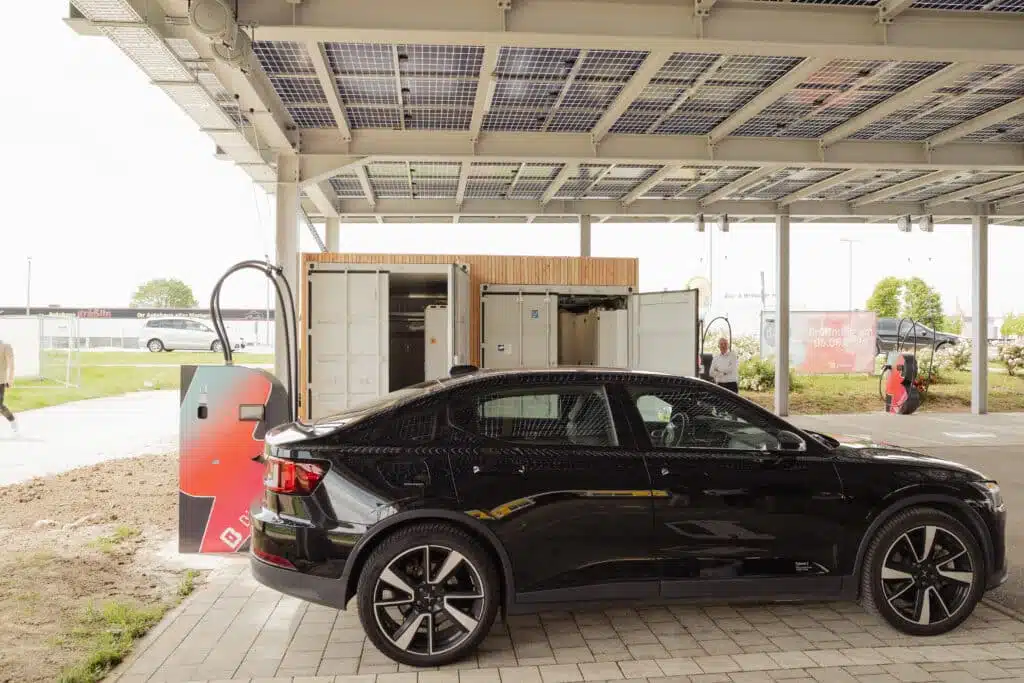
An impressive example of the use of battery storage in charging infrastructure is the charging park of the company Bidirex in Auggen. Here, photovoltaic power is used directly for electric vehicles. When the sun is shining, the electricity comes directly from the covered parking lot, while surpluses are stored in Voltfang commercial storage systems made from overproduced batteries from the automotive industry. This means the solar power generated is ideally used on site without relying on subsidized feed-in tariffs.
The photovoltaic system with a peak output of 450 kW spans a parking lot with 84 parking spaces and generates around 450,000 kWh of electricity per year. This is enough for around 11,000 charging processes. The on-site battery storage has a capacity of 360 kWh, which is sufficient for up to nine average charging processes. Thanks to this combination of solar power and battery storage, the maximum power for all charging points can be provided despite a grid capacity of only 630 kW. (Source 13)
Use cases for commercial storage beyond charging solutions
Battery storage is also used in a variety of ways beyond the integration of charging stations, optimizing companies’ energy efficiency and cost management. The best-known use cases include:
- PV self-consumption optimization: By storing surplus solar power, it can be used at a later time instead of feeding it into the grid for low remuneration (Click to find out more). This model is particularly suitable in residential construction for tenant electricity projects to enable decentralized and cost-efficient power supply.
- Peak shaving: Companies with high energy demand can use battery storage to balance peak loads and significantly reduce their grid fees (Click to find out more). This is particularly advantageous due to regulations such as atypical grid usage or the 7,000-hour rule. You can find out more about the 7,000-hour rule here.
- Dynamic electricity tariffs: Intelligent battery storage makes it possible to buy grid electricity specifically when prices are low and consume it at times of high electricity costs. This can achieve significant savings and reduce dependence on fluctuating energy prices. (Click to find out more)
Conclusion: More cost-effective charging infrastructure with commercial storage
The need for charging infrastructure is growing steadily, and with the new legal requirements, companies must act now. HPC charging stations offer enormous advantages for fleet operations and commercial charging parks, but require a powerful power supply. Battery storage provides an economically viable, scalable and quick-to-implement solution.
Those who invest in smart charging infrastructure today not only secure long-term competitive advantages, but also actively help shape the future of electromobility. Now is the right time to rethink charging infrastructure – efficient, sustainable and economical.
Do you also want to build charging stations?
Whether you already have a project plan or are still in the evaluation phase, we’ll be happy to advise you on your individual charging solution with commercial storage!
Frequently asked questions about charging stations and commercial storage
Similar questions often arise in connection with the purchase and use of charging points. Here you will find answers to some of the most frequently asked questions:
From when are companies required to provide charging points?
Since 2025, according to the German Building Electromobility Infrastructure Act (GEIG), there has been a charging station requirement for commercially used buildings with more than 20 parking spaces. These must provide at least one charging point for electric vehicles.
What is the difference between AC, DC and HPC charging stations?
AC charging stations (alternating current) are mainly used for wallboxes in private settings or at the workplace and allow charging power of up to 22 kW. DC charging stations (direct current) are suitable for public charging parks, commercial fleets or commercial vehicles and offer charging power between 50 and 100 kW. HPC charging stations (High Power Charging) enable very short charging times with 100 to 350 kW, thus increasing the everyday usability of electric vehicles.
Why is a conventional grid connection often not sufficient for several charging stations?
Charging several vehicles at the same time places enormous demands on the local power grid. A conventional grid connection is often not sufficient to supply several vehicles with high charging power at the same time. Expanding the grid connection involves high costs, long approval times and supply bottlenecks for transformers.
How does commercial storage help when building charging infrastructure?
Battery storage makes it possible to operate charging stations independently of the grid connection capacity by acting as a buffer. They store self-generated solar power or pre-purchased grid electricity for later use, shave power peaks when several vehicles are charged at the same time and thus reduce grid fees. Since battery storage solutions can be implemented quickly, companies can generate revenue from their charging infrastructure earlier than with a lengthy grid connection expansion.
What does a concrete practical example look like for the combination of PV system, commercial storage and charging stations?
The charging park of the company Bidirex in Auggen combines a photovoltaic system with 450 kW peak output, a commercial storage system with 360 kWh capacity and a parking lot with 84 parking spaces. The PV system generates around 450,000 kWh of electricity per year, enough for around 11,000 charging processes. Despite a grid capacity of only 630 kW, the combination of solar power and battery storage can provide the maximum power for all charging points.
Can a company generate revenue with a public charging station?
Yes. Companies can make charging stations publicly accessible and generate an additional source of income by selling electricity to customers, visitors or local residents. Fast-charging stations in particular offer great potential, as they enable a high number of charging processes in a short time. In addition, a highly visible charging station can strengthen the company’s image and increase customer frequency.
List of sources
Source 1: https://www.kba.de/DE/Presse/Pressemitteilungen/AlternativeAntriebe/2025/pm03_2025_Antriebe_12_24_komplett.html?snn=3662144 Source 2: https://www.adac.de/news/auto-bilanz-e-autos-2024/ Source 3: https://www.dataforce.de/news/ausblick-flottenmarkt-2025-noch-nie-war-es-so-spannend/ Source 4: https://www.zdf.de/nachrichten/wirtschaft/auto-lobby-co2-grenzwerte-eu-100.html Source 5: https://www.bundesregierung.de/breg-de/aktuelles/ausbau-ladeinfrastruktur-1722304.pdf Source 6: https://www.enercity.de/magazin/unsere-welt/ladesaeulen-typen
Source 7: https://e-mobilio.de/e-wissen/oeffentlich-laden Source 9 https://park-here.eu/ratgeber/e-mobility/ladesaeulen-fuer-unternehmen/#:~:text=Ladestationen%20k%C3%B6nnen%20eine%20Einnahmequelle%20sein,und%20an%20Besucher%20verkauft%20werden Source 10: https://www.goerg.de/de/aktuelles/veroeffentlichungen/06-12-2019/elektromobilitaet-rechtliche-rahmenbedingungen-fuer-die-errichtung-und-den-betrieb-von-ladeinfrastruktur Source 11: https://www.bmwk.de/Redaktion/DE/Artikel/Service/Gesetzesvorhaben/gebaeude-elektromobilitaetsinfrastruktur-gesetz.html Source 12: https://meenergy.earth/magazin/netzanschluss-fuhrpark Source 13: https://bidirex.com/bidirex-ladeparks